
Modifying Workouts for Knee Injuries Without Losing Progress

Last Updated: November 2, 2026
Quick Summary
You can keep training with knee injuries by reducing squat depth to about 90 degrees, supporting single-leg moves with a rail or chair, and swapping high-impact cardio for cycling, swimming, or flat walking. Keep pain at or below 3 during exercise and check the next morning for swelling before adding load, range, or impact.
A half squat stops at roughly 90 degrees of knee bend and most people with knee pain tolerate it well.
Raise the bike seat so your knee stays slightly bent at the bottom, roughly 25 to 35 degrees.
Start with 10 to 15 minutes of easy cycling and add five minutes per week until you reach 30 minutes.
Build four to six weeks of pain-free low-impact work before testing any impact.
If swelling or a limp appears the next morning, cut load and range by roughly a third for a week.
Table of Contents
How to Modify Squats for Knee Pain
Squats remain one of the most effective lower-body exercises, even with knee injuries. The fix is not to quit squatting. It is to change how you squat. (Source: the National Institutes of Health (NIH))
Stopping squatting altogether often leads to lost leg strength, and strength is what helps protect the joint.
Below, we break down exactly how to keep squatting while you modify workouts for knee injuries. We will cover depth, stance, and support so you can train without flare-ups.

Reduce Depth: From Full Squat to Half Squat
Squat depth is the first dial to turn. A full squat drops your hips below your knees. That deep range puts heavy load on the kneecap and surrounding tissue.
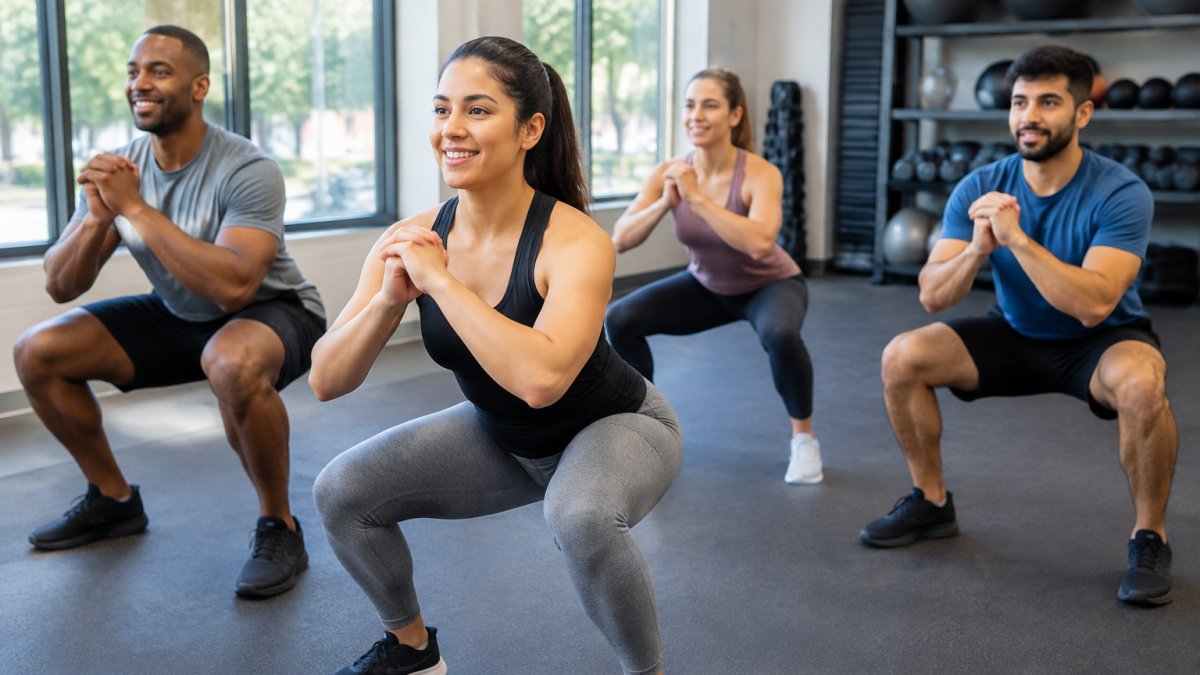
A half squat stops at roughly 90 degrees of knee bend. Most people with knee pain tolerate this range well. You still train the quadriceps and glutes, just through a shorter arc.
Try this progression:
Start with a box or chair behind you as a depth target.
Lower until you lightly touch it, then stand.
Keep your weight in your mid-foot, not your toes.
Stop the set the moment pain rises above a mild ache.
Swap the Split Squat and Stationary Lunge for Supported Versions
Split squats and stationary lunges load one leg at a time. That is great for strength but hard on an angry knee. The fix is support.
Hold a rail, doorframe, or sturdy chair with one hand. This cuts the balance demand and lets you control the knee. Keep your front shin close to vertical and take a shorter step.
A reverse lunge often feels kinder than a forward lunge. Stepping back keeps the front knee from drifting over the toes. If both still hurt, a leg press with a light load is a solid stand-in.
Low-Impact Cardio for Knee Pain That Still Builds Conditioning
Cardio does not have to pound your knees, but it does have to be dosed correctly. The goal is to keep your heart and lungs working while the joint tolerates the load. That means choosing the right mode, setting it up properly, and knowing when to swap.
Tone and Tighten
Cycling is the first pick for most people. A stationary bike lets you set resistance and seat height precisely. Raise the seat so your knee stays slightly bent at the bottom of the pedal stroke, roughly 25 to 35 degrees of bend.
Swimming and water walking remove most weight-bearing load. Water walking in chest-deep water is often easier to tolerate than lap swimming because you control the pace and do not have to manage breathing timing. Start with 10 minutes and build to 20.
Walking on flat ground works too, as long as you keep the pace easy and the surface level. A common pattern is to walk for time rather than distance: 15 minutes at a conversational pace, then add five minutes each week.
Here is a substitution matrix for cardio when a movement flares the knee:
If this flares the knee | Swap to this | Setup cue |
Running | Stationary bike or water walking | Seat height so knee stays slightly bent at bottom |
Jump rope | Rowing machine or arm ergometer | Drive with legs, keep stroke short |
Hill sprints | Flat walking or cycling intervals | Keep resistance low, cadence moderate |
High-impact aerobics | Swimming or marching in place | Chest-deep water or clear floor space |
Stair climber | Recumbent bike | Recline angle reduces knee flexion |
Skip running, jumping, and hill sprints for now. A common mistake is returning to high-impact cardio too soon because the knee felt fine during a warm-up. Build a base of four to six weeks of pain-free low-impact work before you test any impact.
Progression for cardio follows the same rules as strength: add time before you add intensity, and add intensity before you add impact.
For readers who cannot use gym machines, the equipment-free options are marching in place, step-ups to a low box, and seated arm ergometry with light weights. All three keep the heart rate up without loading the knee through deep flexion.
Knee Strengthening Exercises at Home to Build Support
Strong leg muscles are the best brace you own. The quadriceps, hamstrings, and calf muscles form three pillars of knee stability.
Here is a simple home plan:
Quad sets: Sit with the leg straight, tighten the thigh, hold 5 seconds.
Straight leg raises: Lie down, lift the straight leg, lower slowly.
Heel slides: Slide the heel toward your glutes to work range of motion.
Calf raises: Rise onto your toes, hold, lower with control.
Quadriceps, Hamstrings, and Calf Muscles: The Three Pillars
Each muscle group plays a different role in knee support. The quadriceps help control the knee as it straightens, the hamstrings help stabilize the back of the joint, and the calf muscles absorb load with each step.
Train all three, not just the quads. A balanced leg protects the joint better than one strong muscle group.
For a full safe strength plan, see our guide on fitness training for knee pain.
Knee Pain Exercises to Avoid (and What to Do Instead)
Some movements are worth pausing. Deep squats, jumping lunges, box jumps, and full-depth leg extensions load the knee hard.
Here is a quick swap list:
Avoid | Do Instead |
Deep squats | Half squats to a box |
Jump lunges | Supported reverse lunges |
Box jumps | Step-ups to a low box |
Running | Cycling or swimming |
Full leg extensions | Short-range extensions, light load |
Watch out: pushing through sharp pain "to toughen up" is the fastest way to a longer layoff. A mild ache is a signal to slow down. Sharp pain is a signal to stop.
Your Pain-Monitoring Rules and Return-to-Training Plan
Pain is your best coach here, but only if you use it like a gauge instead of a guess. The single most useful tool is a simple 0-10 scale, where 0 is no pain and 10 is the worst pain you can imagine. Many trainers and clinicians use a rough guide that mild discomfort may be acceptable during exercise if it settles soon after, but individual guidance should come from a qualified professional.
The rules that matter most are the ones you apply after you leave the gym:
During exercise: Keep pain at or below 3. If a rep pushes you to 4 or higher, stop the set, reduce range or load, and finish with an easier variation.
Within two hours after: The knee should return to its baseline ache level. If it is still angry two hours later, the session was too much.
The next morning: Check for swelling, stiffness, or a limp. If any of those appear, cut load and range by roughly a third next time and hold there for a week.
Two days later: If symptoms are back to baseline and you can repeat the session without a next-day flare, you have earned a small progression.
Progression is where most people go wrong. They add depth, weight, and speed all at once, then wonder why the knee flared. Add one variable at a time and give each change at least two sessions before you touch the next dial. A common pattern is to spend two weeks adding range, then two weeks adding resistance, then two weeks adding speed or impact. Progression timelines vary widely, so the pace should be set by how your knee responds.
Return-to-training criteria are concrete, not motivational. You are ready to add impact when you can do three consecutive sessions of your current program with no next-day swelling, no stiffness that lasts more than an hour, and pain that stays at or below 2 throughout. You are ready to add load when you can complete all prescribed sets and reps with pain at or below 2 and no evening flare.
Watch out: the most common mistake is judging a session by how it feels in the moment. Knees often report back the next morning, so the next-day check is the real test, not the mid-set ache.
If you are unsure how to start safely, our guide on how to start working out safely covers warm-ups and warning signs.
Book a Coaching Session to Build Your Modified Program
Every knee is different. A plan that fits one person may not fit you. That is where coaching helps.
At Stay Fit Culture, our trainers build personalized programs around your knee, your goals, and your stage of recovery. We offer 30-minute sessions, expert-led classes, and a supportive community that keeps you showing up.
If you are ready to book, here is how to book a personal fitness coaching session step by step. Curious what other clients have achieved? See our client results for real stories.
Frequently Asked Questions
How do you modify a workout for a knee injury?
Start by reducing range of motion, resistance, and impact. Swap full squats for half squats, replace jumping movements with marching in place, and use lighter weight with more controlled reps. Keep proper form and stop any movement that causes sharp pain. A qualified coach can help you build a safe conditioning program that works around your knee injury while you recover.
What exercises should I avoid with knee pain?
Avoid deep squats, high-impact jumping, running on hard surfaces, and heavy leg press with full extension. Also skip any movement that causes sharp or lingering pain. Instead, choose low-impact cardio like cycling or swimming, and focus on knee strengthening exercises at home such as leg raises and gentle knee extension. Always check with a medical professional before starting a new routine.
Can I still work out if my knee hurts?
In many cases, yes, with modifications. Use pain-monitoring rules: some discomfort may be manageable, but sharp pain or swelling is a reason to stop and check with a professional. Focus on upper-body and core training, low-impact cardio, and knee-friendly exercises. If pain persists or worsens, seek medical assessment before continuing.
What cardio is easiest on the knees?
Stationary cycling, swimming, walking on flat surfaces, and marching in place are generally easiest on the knees. These low-impact options reduce joint load while still building cardiovascular health. Start with short sessions and gradually increase duration. Avoid running or jumping until your knee stability improves and pain has resolved.
Your knee does not have to sideline you. With the right modifications, you can keep training and keep your progress. Get started with Stay Fit Culture and reserve your 30-minute session to build a program made for your body.



Comments